Our Mission
The purpose of BBTI is to fill a need that exists in the preparation of Baptist missionaries for the foreign field. There are
many good Bible colleges and institutes that can aid the churches in teaching and preparing people for the ministry in
general. However, we see the missionary as a specialist in need of specialized training and linguistic skills that he cannot
get in a traditional Baptist college or institute. Our goal is to prepare the missionary to plant strong, indigenous Baptist
churches in any part of the world, whether in the jungle or the city. He learns linguistic principles and skills that apply to
any language, written or unwritten. It is expected that the BBTI graduate will learn the new language more quickly and
accurately than the missionary without this specialized preparation. He is taught to study and learn the culture of a
people and, as much as possible, to become bi-cultural. He studies principles of Bible translation, enabling him to
translate the Scriptures where needed—and that need exists for thousands of languages. Many missionaries return home
prematurely because of difficulties, dangers, and obstacles faced on the field. Our goal is to prepare the missionary to
overcome such obstacles.
Specialized Missionary Training
Baptist Bible Translators Institute exists for several reasons. First, there is an unfilled gap in world evangelism. More than
3,000 languages with 380 million people still await the Word of God in their language. BBTI exists to help meet this need.
This need exists because missionaries are usually trained to be pastors in the USA but are not trained to deal with
crossing language and cultural barriers in remote parts of the world. So those parts of the world that are similar to the
USA have been the places to which missionaries have most often gone. This leaves the geographically difficult areas of the
world neglected. The people who live there speak a strange language, and their customs are harshly different from
anything with which we are familiar.
The principles of linguistics, ethnology, and cross cultural communication that are taught at BBTI are universal to all
missionary situations. Missionaries are prepared to meet whatever challenge they will face, whether in the city or the
jungle. In either place, missionaries must learn languages and adjust to cultures that are very different from their own.
BBTI exists to train missionaries to be effective, cross-cultural communicators. It is one thing to speak to people who
share your language and culture. It is a different matter to speak to people who have a different language and culture.
BBTI trains missionaries to become preachers and teachers of the Gospel of Christ in cross-cultural situations. Because
the principles of Bible translation are taught at BBTI, some students will become Bible translators. These Bible translation
principles can save each missionary from having to learn all over again the same lessons learned already by other Bible
translators. His progress as a Bible translator can be sped up and his work made more efficient. He will also be more
effective in communicating the message of the Bible in another language.
Training for Teamwork
BBTI also exists to help missionaries learn to work together as a team. First, the missionary is encouraged to be a vital part
of his home church team. From this as a basis, he is encouraged to learn how to work with other missionaries as well.
Church planting requires the gifts and skills of many individuals. There is a need for those who will preach and teach in
the local language. There is a need for those who will translate Scripture. There is a need for those who will teach illiterate
people to read so they can read the translated Scriptures. There is a need for those who will maintain a supply line to the
missionaries by an airplane, truck, or boat. Those who will help to educate their children are also needed, as well as those
who will help them with building construction, printing materials, medical supplies, and many other matters that
become necessary for the establishing of New Testament Baptist churches. The training program at BBTI puts
missionaries in situations where they learn to work together. Each afternoon is used for Work Detail. During this time
students work together to do many kinds of work. Work Detail is one of the most valuable training experiences at BBTI
because it involves people learning to work cooperatively with other people. A very valuable lesson indeed!
Missionaries Training Missionaries
BBTI also exists because there is a need for missionaries to train missionaries. This agrees with the Biblical principle of
each “after his kind.” After people have been trained in their home church, and have proven themselves faithful there, they
are ready to be trained by other missionaries.
Although spiritual needs will not be ignored, their training will involve the more practical and technical aspects of
missionary work. BBTI can help train missionaries in the technical aspects of phonetics, phonemics, morphology, syntax,
language learning principles, cross-cultural communication principles, Bible translation principles, and ethnology.
Along with these subjects, the daily work detail teaches many lessons of a practical nature, such as electrical repair,
plumbing, building construction—anything that has to be done at the time. BBTI can also help prepare missionaries for the
responsibility of educating their children on the mission field. All of these situations are designed to be very similar to
those conditions found on mission fields all over the world.
Our History
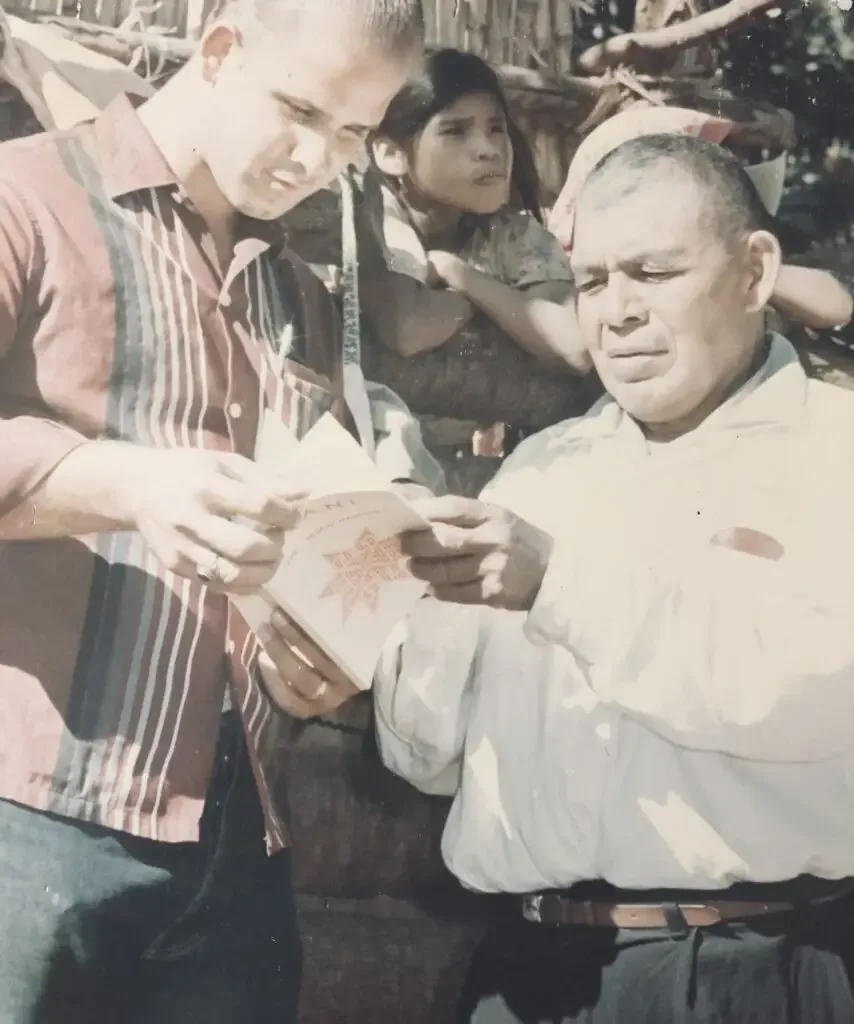
The idea for a Baptist missionary training school was born as a result of an initial missionary trip into the Tlapaneco Indian area of Guerrero, Mexico, made by Missionary George Anderson and Pastor Paul Henderson.
When Brother Anderson tried to live among the Indians and teach them, he discovered that their understanding of Spanish was very limited. He also realized that he had no idea how to learn their unwritten language. He wrote to his Bible college and to several other Baptist schools asking this question: “Do you teach missionaries how to learn languages?” They all replied, “No.”
George and his wife, Sharon, left the field and enrolled in a linguistic training program with the purpose of starting a similar school for Baptists. Thus, in 1973, the Baptist Bible Translators Institute began in Ft. Worth, Texas. The following year the school was moved to its present location near Bowie, Texas.
Brother Anderson left BBTI to pastor a church in 1991, and veteran missionary Charles Turner became the director. Rex and Mary Cobb joined the staff in 1999, and Rex was appointed director in 2005.
Since the founding of BBTI, graduates have gone to Indonesia, the Philippines, Kazakhstan, Mexico, Bolivia, Mongolia, Cambodia, Papua New Guinea, Chile, the Chippewa Indians, Tanzania, Colombia, Thailand, Costa Rica, Uganda, Hungary, Ukraine, Vanuatu, Venezuela, Cameroon, Lithuania, South Korea, and some closed countries.
From the Director
Missionaries are too valuable, the Gospel is too important, and the field is too demanding for preparation to be
an afterthought. Jesus said, “The children of this world are in their generation wiser than the children of light”
(Luke 16:8). That statement should challenge us. We should not be careless with the missionary task. That
conviction is at the heart of the Baptist Bible Translators Institute.
If you are concerned about the Great Commission of our Lord, I believe you will appreciate the work of BBTI.
We exist to provide Advanced Missionary Training for Baptist missionaries who are preparing for cross-cultural
ministry. The missionary’s task is serious. He must learn a new language, understand a different culture,
communicate biblical truth clearly, and build relationships with people whose way of thinking may be very
different from his own. That kind of preparation should not be left to chance. Our intensive nine-month
program, running from mid-August through mid-May, is designed to help missionaries arrive on the field better
prepared for the realities they will face. Language learning, culture acquisition, phonetics, literacy, Bible
translation principles, and practical missionary issues are all part of preparing a missionary for long-term
effectiveness. We understand the value of preparation in other areas of life. Soldiers and Marines are sent into
difficult places with serious training. Businesses train employees before giving them major responsibilities.
Even religious groups with false doctrine have seen the value of specialized missionary preparation. Should not
those who carry the true Gospel of Jesus Christ be willing to prepare carefully for the work of missions?
Missionary attrition is a real concern. Too many missionaries spend years raising support only to struggle
greatly once they arrive on the field. When a missionary is unprepared for language, culture, family pressures,
paperwork, isolation, or the daily challenges of field life, the results can be discouraging for the missionary,
disappointing for supporting churches, and harmful to the work they were sent to do.
For missionaries still raising support, BBTI does not have to bring deputation to a halt. Our campus is located
within three hours of hundreds of Independent Baptist churches, giving missionaries opportunities to continue
scheduling meetings while receiving training during the school year.
The Gospel deserves clear communication. The missionary deserves careful preparation. The churches that
send and support missionaries deserve confidence that their missionaries are being equipped for the work
ahead.
Please prayerfully consider the value of BBTI’s nine-month Advanced Missionary Training. Specialized
preparation can make a real difference in a missionary’s ability to learn, adapt, communicate, and remain
faithful on the field.
Our Doctrine
Read Our Doctrine
Of the Scriptures
We believe the Holy Bible was written by men supernaturally inspired by God and what they wrote is truth
without any mixture of error and is therefore the only complete and final revelation of the will of God to
mankind. We believe the King James Version to be this Holy Bible, the inspired, preserved Word of God in the
English language. We do not mean that the English language translators were inspired as they translated.
However, because what they translated is an accurate and faithful translation of the inspired Hebrew and
Greek texts, the King James Version is therefore the inspired, preserved Word of God in the English language.
We believe the Masoretic Hebrew text and the Textus Receptus Koine Greek text to be the inspired, preserved
Word of God in the Hebrew and Koine Greek languages. (II Peter 1:19-21, II Timothy 3:16-17, Psalm 119:160, John
12:43)
Of the True God
We believe there is one, and only one, living and true God and that in the unity of the Godhead there are three
persons, the Father, the Son, and the Holy Spirit.
(Exodus 20:2-3, I Corinthians 8:6, Ephesians 4:6, John 4:25)
Of the Son
We believe that Jesus the Christ, is the Son of God and God the Son; that he is divine and equal to the Father
and was human in every sense except that he had no sin.
(Hebrews 4:15, John 14:9, John 5:18)
Of the Virgin Birth
We believe that Jesus was born of the Holy Spirit in a miraculous manner; born of Mary, a virgin, and that he is
God’s divine Son.
(Genesis 3:15, Matthew 1:18-25, Luke 1:35, Galatians 4:4, I John 5:20)
Of the Holy Spirit
We believe the Holy Spirit is a divine person, equal to God the Father and God the Son. He exalts Christ and
convicts lost sinners. He indwells all believers and baptizes them into Jesus Christ at the moment of salvation.
We do not agree with the Pentecostal and Charismatic doctrines of the Holy Spirit.
(Ephesians 4:30, John 14:16-17, John 14:26, Romans 6:3; 8:26-27; 1 Cor. 6:19; 12:13)
Of Satan
We believe that Satan is a real person who is the enemy of God and His Christ.
(Isaiah 14:12-15, Ezekiel 28:14-17, Revelation 12:9)
Of Creation
We believe in the Genesis account of the seven days of creation of the world by God and that this account is
not figurative and that mankind was created directly by God in the image of God.
(Genesis 1:1, Exodus 20:11, Genesis 1:11, Acts 17:23-26)
Of the Fall of Mankind
We believe mankind voluntarily sinned and fell from a sinless state into a sinful one, in consequence of which,
all people are now sinners under the just condemnation of God.
(Genesis 3:1-6, Romans 5:12, Romans 5:19, Ephesians 2:1,3)
Of the Atonement for Sin
We believe that the salvation of sinners is wholly by the grace of God; through the mediatorial work of the
Lord Jesus Christ who by his death on the cross made a full and vicarious atonement for the sins of the whole
world. Therefore, there is salvation only in Christ Jesus.
(Ephesians 2:8-9, Acts 15:11, Romans 3:24-25, John 3:16, Hebrews 9:12-15, Acts 4:12, I John 2:2)
Of Grace in the New Creation
We believe that in order to be saved, sinners must be born again; that the new birth is instantaneous and not a
process.
(John 3:3, II Corinthians 5:17, I John 5:1, Romans 6:23)
Of the Freeness of Salvation
We believe in God’s grace; that the blessings of salvation are made free to all in the gospel message; that it is
the responsibility of all to accept by faith the promise God has made to save all who believe in his Son, the
Lord Jesus Christ.
(I Thessalonians 1:4, Colossians 3:12, I Peter 1:2, Titus 1:1)
Of Justification
We believe that the gospel blessing which Christ secures to those who believe in Him is justification before
God and includes the pardon of sins, and the gift of eternal life; that a person can be justified only through the
shed blood of the Lord Jesus Christ.
(Acts 13:39, Isaiah 53:11, Acts 5:1-2, Romans 5:9, Ephesians 1:7)
Of Repentance and Faith
We believe that repentance and faith are the result of the convicting power of the Spirit of God whereby we
turn to God for mercy and, at the same time, by faith receive Jesus Christ as our Lord and Saviour.
(Acts 20:21, Mark 1:15, Romans 10:9-11, Acts 16:30-31)
Of a Local Church
The believer is instructed to be baptized in water and unite with a biblically sound local church where he can
assemble, receive instructions, exercise his spiritual gifts, participate in the work of the Great Commission,
and provoke others to love and good works (Matt. 18:17; Acts 2:41; 1 Tim. 3:15; Heb. 10:24-25).
Of Baptism and the Lord’s Supper
We believe that baptism is the immersion in water of a believer in Christ in the name of the Father, of the Son,
and of the Holy Spirit; that such baptism should only be done with the authority of a local church; that it is
prerequisite to the privileges of a church relationship and to the Lord’s supper; in which the members of a
local church, by the sacred use of bread and the fruit of the vine commemorate together the broken body and
the shed blood of Christ.
(Acts 8:36-39, Matthew 3:6, Romans 6:3-5, Acts 2:41-42, I Corinthians 11:23-28)
Of Civil Government
We believe that civil government is of divine appointment, and is for the good order of human society; that
magistrates are to be prayed for and obeyed: except in things opposed to the will of our Lord Jesus Christ.
(Romans 13:7, Acts 23:5, Titus 3:1)
Of the Resurrection and Return of Christ to Earth
We believe that Christ rose bodily from the grave, that he ascended to the right hand of God, and that He will
come again. We believe in a pre-tribulation rapture. We believe that Christ shall reign a thousand years on
earth until he puts all enemies under his feet.
(Matthew 28:6-7, John 20:27, I Corinthians 15:4, I John 2:1, I Thessalonians 4:16)
Of Missions
We believe the command of Christ to preach the gospel to all nations is clear and that this commission was
given to the churches to carry out.
(Matthew 28:18-20, Mark 16:15, Romans 10:13-15)
FAQ
What is BBTI?
Baptist Bible Translators Institute provides Advanced Missionary Training for Baptist missionaries
preparing for cross-cultural ministry. Our program helps missionaries prepare for language learning,
culture acquisition, literacy, Bible translation principles, and the practical realities of missionary life.
Is BBTI only for Bible translators?
No. While Bible translation principles are an important part of our training, BBTI is not only for
missionaries planning to be full-time Bible translators.
Any missionary serving in another language and culture needs tools for language learning, cultural
understanding, clear communication, and long-term field readiness. BBTI is designed to help
missionaries become more effective in cross-cultural ministry.
Who should attend BBTI?
BBTI is designed for Baptist missionaries preparing to serve in cross-cultural ministry. This includes
missionaries planning to serve in church planting, Bible teaching, evangelism, discipleship, literacy
work, Bible translation, or other field ministries where language and culture are major factors.
Missionary families, single missionaries, and those preparing for long-term foreign missions can all
benefit from the training.
How long is the program?
BBTI is a nine-month program running from mid-August through mid-May.
Can missionaries continue deputation while attending BBTI?
Yes. Missionaries who are still raising support may continue deputation while attending BBTI. Our
campus is located within three hours of hundreds of Independent Baptist churches, giving
missionaries opportunities to schedule meetings during the school year while continuing their training.
What classes are included?
Courses may include language learning, phonetics, linguistics, culture acquisition, literacy, Bible
translation principles, teaching English as a foreign language, missionary issues, and other practical
preparation for cross-cultural ministry.
The goal is not merely to give students information, but to prepare them with tools they can use on the
field.
Why is language training so important?
Language is one of the missionary’s most important ministry tools. Without the ability to communicate
clearly, a missionary may struggle to preach, teach, disciple, counsel, and build meaningful
relationships.
BBTI helps missionaries understand how language works so they can approach language learning
with better tools and greater confidence.
Why is culture training necessary?
Missionaries do not only cross geography; they cross ways of thinking, communicating, relating, and
understanding the world. Cultural misunderstanding can create unnecessary barriers to the Gospel.
BBTI helps missionaries learn how to observe, understand, and adapt to another culture without
compromising biblical truth.
What makes BBTI different from a Bible college or seminary?
Bible colleges and seminaries are valuable, but many do not provide specialized training for learning
unwritten languages, understanding culture, developing literacy, or handling the daily realities of
cross-cultural missions.
BBTI is not intended to replace Bible college, the local church, or a mission board. It provides focused
missionary preparation that helps fill a specific training need before the missionary reaches the field.
Is BBTI a mission board?
No. BBTI is not a sending agency or mission board. We do not replace the authority of the sending
church or the role of a mission board.
Our purpose is to assist churches and missionaries by providing specialized training for cross-cultural
ministry.
Is BBTI connected with a local church?
BBTI operates in partnership with Bible Baptist Church in Bowie, Texas. We believe missionary training
should be rooted in a strong local church context and should support the work of Bible-believing
Baptist churches.
Where is BBTI located?
BBTI is located near Bowie, Texas, on a rural campus that provides a practical setting for missionary
training, family life, and hands-on learning.
Is housing available?
Yes. Housing is available on campus at a modest cost, depending on availability and family needs.
Students are responsible for their own meals and personal expenses.
What does it cost to attend?
BBTI has historically worked to keep missionary training affordable. Tuition information, housing costs,
and other expenses should be confirmed directly with BBTI, since costs may change from year to year.
Can families attend?
Yes. Missionary families are welcome. Since missionary preparation affects the whole family, BBTI’s
training environment can be especially helpful for couples and families preparing for the field
together.
Can single missionaries attend?
Yes. Single missionaries preparing for cross-cultural ministry can benefit greatly from BBTI’s training.
Do students need previous language training?
No. Students do not need to arrive with previous linguistic training. BBTI is designed to give students a
working foundation in language learning and cultural preparation.
Will BBTI teach me the language of my field?
Usually, no. BBTI is not designed to teach every missionary their specific field language. Instead, BBTI
trains missionaries how to learn languages more effectively, including languages that may not have a
formal language school.
What if there is a language school on my field?
A field language school can be very helpful, but BBTI can still strengthen a missionary’s ability to
succeed in that school. Students learn how sounds, grammar, meaning, culture, and communication
work, giving them tools that apply to almost any language-learning situation.
What if there is no language school on my field?
This is one of the major reasons BBTI exists. Many missionaries serve where there is no formal
language school available. BBTI helps prepare missionaries to learn from native speakers, organize
what they are learning, and build toward real communication.
Does BBTI help with Bible translation?
Yes. BBTI teaches Bible translation principles and helps missionaries understand the challenges
involved in communicating Scripture clearly and faithfully across languages.
Not every graduate will become a full-time Bible translator, but every missionary benefits from
understanding how meaning, language, and culture affect the communication of biblical truth.
Will this training help church planters?
Yes. Church planters must evangelize, disciple, preach, teach, counsel, and train leaders in a language
and culture that may be very different from their own. BBTI helps church planters communicate more
clearly and minister with greater understanding.
Is this training useful for missionaries going to countries that already speak English?
It can be. Even in places where English is used, missionaries often serve among people with different
cultural assumptions, regional languages, or local ways of communicating. The value of BBTI is
especially strong where language and culture learning will be a major part of ministry.
Why should a missionary attend before going to the field?
The field is a difficult place to discover that basic preparation is missing. BBTI allows missionaries to
gain tools, ask questions, build habits, and face realistic challenges before they are under the pressure
of field life.
How does someone apply?
Those interested in attending BBTI should contact the school directly for current application
information, schedule details, housing availability, and any needed references or approvals.
Who can I contact for more information?
For more information about Baptist Bible Translators Institute, Contact us.